When planning breast augmentation, many people want natural feel and contour and upper-pole volume as well as size. That is when hybrid breast augmentation — implant insertion combined with autologous fat grafting — can be considered. The implant creates the volume and basic shape, and fat harvested from the abdomen or thighs is grafted into the breast to refine the contour around the implant. Because it uses the characteristics of both methods, the surgical plan and the purpose of the fat grafting differ from implant-only augmentation. The key is to separate the roles of implant and grafted fat and design them to suit your breast tissue and body.
Contents
What is hybrid breast augmentation?
Hybrid breast augmentation combines silicone implant insertion with autologous fat grafting. The implant creates overall volume and projection, while fat grafted around the implant or into the upper pole connects the contour naturally. Implant-only surgery is easier to plan in size and shape; fat grafting can use your own fat to fill volume that is lacking. Hybrid augmentation combines the implant's volume-forming capacity with fat grafting's contouring effect.
What role does each method play?
Implant: basic volume and shape. The implant is the central element in designing breast size, projection and overall shape. Its size, shape and position are decided with reference to breast width, chest wall shape and existing breast tissue, so body analysis before surgery is needed.
Fat grafting: fine contour and volume. Fat is harvested from the abdomen or thighs, separated from impurities and injected into the breast after purification. It is used mainly to soften the implant's edge, fill the upper pole and adjust small left–right differences. Some of the grafted fat survives and some is absorbed, so volume right after surgery differs from volume once the fat has settled; after that, volume can change with body weight, so keeping weight stable helps.
In a systematic review of 382 patients having primary composite augmentation, an average of 109 mL of fat per breast was placed mainly at the medial border, with a 3.7% revision rate.[1]
Read alsoWhy implant and fat are combined is covered in “Hybrid breast augmentation for a thin body” (Korean).
What characterises hybrid augmentation?
The point is not simply performing two procedures together, but separating their roles to design overall shape and fine contour as one.
Upper-pole volume: where the upper breast looks hollow or the border between implant and existing tissue shows, fat can soften the transition.
Implant border: with thin skin and breast tissue the implant's edge or surface folds can be visible; grafting fat there helps reduce the prominence of the border.
Proportions to the body: breast width, the gap between the breasts and left–right asymmetry can be planned alongside chest wall shape.
Use of your own tissue: because your own fat is used, the volume and feel where it survives carry natural tissue characteristics.
Fat grafting does not hold a fixed volume the way an implant does. The plan therefore centres on the implant forming basic volume while fat refines detail.
In a systematic review of 22 studies (3,565 patients) of cosmetic breast fat grafting, average fat retention was 62.4%.[2]
When can it be considered?
Hybrid augmentation can be considered when you want the implant to provide the size you want while improving fine contour at the same time.
First, where thin skin and breast tissue make the implant border likely to show, fat can be grafted around the implant to smooth the transition to existing tissue.
Second, where the upper breast is hollow or the volume difference between the central and outer breast is a concern, fat can refine specific areas separately from overall size.
Third, where the shape of the two breasts or the chest wall differs, the implant size and position can be adjusted while fat fills the areas needed to correct asymmetry.
Fourth, where fat grafting alone would not add enough volume but implant-only surgery would struggle to create a natural contour, a plan combining both can be reviewed.
What should be checked before surgery?
Because implant insertion and fat harvest and grafting are performed together, both plans must be built at once. First, separate the volume the breast needs from the areas to be refined with fat, and confirm that enough fat can be harvested. Tell the medical team about any history of breast disease, previous surgery, current medication and smoking. Depending on breast condition, preoperative breast ultrasound or mammography may be arranged.
After fat grafting, fat necrosis, oil cysts and calcification can occur. These changes can be seen on imaging, so recording the preoperative breast condition and reporting the surgical history to future imaging staff matters.
Recovery and aftercare
After hybrid augmentation, swelling, bruising and discomfort can appear at the implant site and at the fat donor sites. Early on, wear the prescribed compression garment and support bra as instructed, and avoid upper-body strenuous exercise or heavy lifting for the period advised. Depending on the technique, pressing or massaging the breast may also be restricted. While the grafted fat settles, adjust activity to your recovery. Some fat may be absorbed even after early swelling subsides, so the final contour is assessed through the recovery course rather than immediately after surgery.
Hybrid breast augmentation: common myths and facts
| You may think… | In practice |
|---|---|
| "Hybrid means half implant, half fat." | The implant provides volume, fat provides border and contour. |
| "All grafted fat stays." | Retention varies between individuals. |
| "Everyone needs hybrid." | With enough tissue, an implant alone may be sufficient. |
I explain hybrid as “the implant is the frame, fat is the finish”. Volume is set by the implant; fat is placed thinly only where the border is likely to show.
Hybrid breast augmentation creates the basic size and shape with an implant and refines the area around it and the fine contour with autologous fat. It allows upper-pole volume, an implant border that might show in thin tissue, and small left–right differences to be addressed together. What matters is not just choosing an implant size but designing the role of each method around your chest wall, breast tissue, skin thickness and available fat.
🔬 The research behind this article
These are the international journal papers that support the content above. Select a title to open the abstract on PubMed.
- PRS Global Open 2019 — systematic review of primary composite augmentation, 382 patientsSalibian AA, Frey JD, Bekisz JM, Choi M, Karp NS. Fat Grafting and Breast Augmentation: A Systematic Review of Primary Composite Augmentation. Plast Reconstr Surg Glob Open. 2019;7(7):e2340.Key: average 109 mL of fat, revision rate 3.7%Text [1] · PMID 31942362 · DOI
- Aesthetic Surgery Journal 2016 — 22 studies and 3,565 patients of cosmetic breast fat graftingGroen JW, Negenborn VL, Twisk JW, Ket JC, Mullender MG, Smit JM. Autologous Fat Grafting in Cosmetic Breast Augmentation: A Systematic Review on Radiological Safety, Complications, Volume Retention, and Patient/Surgeon Satisfaction. Aesthet Surg J. 2016;36(9):993-1007.Key: average retention 62.4%Text [2] · PMID 27329661 · DOI
🎬 Watch: Dr. Park Seong-Soo on video
Korean-language videos from BongBong Plastic Surgery's official channel and Dr. Park's channel, “Seongsu-ro Doctor”. Titles are translated for reference; selecting one opens YouTube.
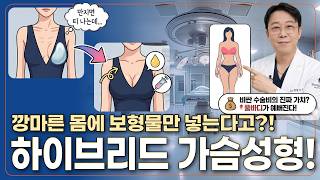
- What is hybrid breast augmentation? Combining implant and fat graftingSeongsu-ro Doctor · 2026.08.19
- Hybrid breast augmentation: advantages, disadvantages and resultsSeongsu-ro Doctor · 2026.03.17
- Why breast implants show, and how hybrid augmentation solves itSeongsu-ro Doctor · 2026.08.21


Frequently asked questions
How is hybrid different from implant surgery?
A. Implant surgery forms volume and shape with the inserted implant. Hybrid augmentation adds autologous fat grafting to refine the border around the implant and the contour of specific areas.
Where is the fat harvested from?
A. Generally from the abdomen, thighs or flanks. The donor site is decided according to the amount of fat needed and body shape.
Does all the grafted fat survive?
A. Not all of it. Some is absorbed and some survives, and the amount is influenced by fat quality, grafting technique and tissue environment.
Can a thin person have hybrid augmentation?
A. It can be considered, but whether enough fat can be harvested must be confirmed. If fat is limited, the grafting range and surgical plan are adjusted.
Can I have breast ultrasound or mammography afterwards?
A. Yes, but fat necrosis or calcification can produce changes on imaging. Report the implant insertion and fat grafting history and follow the imaging team's guidance.
📖 References
Select a [number] in the text to jump to the source, and ↩ to return. Only papers whose title, journal and year were verified on PubMed are included.
- Salibian AA, Frey JD, Bekisz JM, Choi M, Karp NS. Fat Grafting and Breast Augmentation: A Systematic Review of Primary Composite Augmentation. Plast Reconstr Surg Glob Open. 2019;7(7):e2340. — PRS Global Open 2019 — systematic review of primary composite augmentation, 382 patients. ↩
- Groen JW, Negenborn VL, Twisk JW, Ket JC, Mullender MG, Smit JM. Autologous Fat Grafting in Cosmetic Breast Augmentation: A Systematic Review on Radiological Safety, Complications, Volume Retention, and Patient/Surgeon Satisfaction. Aesthet Surg J. 2016;36(9):993-1007. — Aesthetic Surgery Journal 2016 — 22 studies and 3,565 patients of cosmetic breast fat grafting. ↩
BongBong Plastic Surgery · Dr. Park Seong-Soo, Medical Director
Contact us for a consultation