Hybrid breast augmentation uses an implant to create the breast volume you need and grafts your own fat at the same time to add tissue thickness around the implant and refine the breast contour. It is especially useful when the skin and fat covering the breast are thin, or when implant edges or rippling might show, because the implant and fat can be planned to do different jobs. Rather than thinking of it as “an implant plus extra fat,” it is better understood as the implant creating overall size and projection while the fat fine-tunes specific areas.
Contents
- What is hybrid breast augmentation?
- Why use implants and fat together?
- How is it different from implant-only augmentation?
- Where is the fat grafted?
- Can hybrid breast augmentation be considered for slim bodies?
- What are the limits and side effects of hybrid breast augmentation?
- What should be checked before surgery?
- Sources
- Hybrid breast augmentation: common myths and facts?
What is hybrid breast augmentation?
Hybrid breast augmentation is a breast augmentation method that uses both a silicone implant and fat grafting. The two are combined because each does a different job well. Implants are good at creating consistent size and projection, but when the skin or subcutaneous fat is thin, the implant edges or folds may be felt or seen from the outside.
Your own fat can soften specific areas using your own tissue, but not all grafted fat survives, and fat alone has limits when creating large volume. The hybrid approach divides the roles: the implant carries the central volume and the fat reinforces the soft tissue and contour over it.
Related readingThe basic concept of hybrid breast augmentation is covered in “What Is Hybrid Breast Augmentation? Why Implants and Fat Are Used Together” (Korean).
Why use implants and fat together?
The main reason for adding your own fat is that it can add soft tissue over the implant exactly where it is needed. Once an implant is placed, it is covered by existing breast tissue, fat and skin. If this tissue is thick enough, the implant outline is hard to see; in slim bodies or with thin skin, the implant edge may be felt or wave-like rippling may appear.
In such cases, your own fat can be used to reinforce areas such as:
Thin tissue in the upper breast
The inner breast and cleavage area
Implant edges
Small volume differences between the breasts
Contour differences caused by chest-wall shape
Research on composite breast augmentation also found that fat was mainly used to make up for thin soft-tissue coverage over the implant and to adjust the inner breast and overall contour.
A systematic review of 382 patients who had implants and fat together as a first surgery found that an average of 109 mL of fat per breast was placed, mainly along the inner breast border, and the overall reoperation rate was 3.7%.[1]
How is it different from implant-only augmentation?
The biggest difference is that tissue thickness over the implant and fine contour details can also be adjusted with your own fat.
| Item | Implant only | Hybrid breast augmentation |
|---|---|---|
| Overall volume | From the implant | Mainly from the implant |
| Soft-tissue reinforcement | Relies on existing skin and fat | Fat can be added where needed |
| Implant edges | May show if tissue is thin | Can be partly softened with fat |
| Left–right fine-tuning | Adjusted with implant size and position | Fat volume can be adjusted area by area |
| Fat harvesting | Not needed | Needs harvesting from the abdomen, thighs, etc. |
| Fat survival | Not applicable | Some fat may be absorbed |
So if your existing breast tissue is ample and covers the implant well, a hybrid approach is not necessarily needed. On the other hand, when an implant alone can create the size but certain areas need extra tissue thickness or contour, a hybrid approach can be considered.
Where is the fat grafted?
In hybrid breast augmentation, rather than placing fat in one spot, it can be divided across the areas and tissue layers where it is needed. Grafted fat must receive blood supply from surrounding tissue to survive, so small amounts are spread across many locations.
Fat can also be grafted into different layers — in front of the pectoralis major, beneath the breast gland and in the subcutaneous tissue. Rather than thickening tissue over the implant in a single layer, this approach reinforces what is needed across several layers.
The location and amount of fat are not the same for everyone. They depend on skin thickness, existing breast tissue, implant position and the contour you need.
Can hybrid breast augmentation be considered for slim bodies?
Slim bodies are one of the cases where hybrid breast augmentation can be considered. With little body fat and thin breast skin and subcutaneous fat, the tissue covering the implant may also be thin. In such cases, the chance of implant edges or rippling being felt from the outside must be considered.
Studies of composite breast augmentation also reported underweight patients or those with little subcutaneous tissue as a main group treated. But slim bodies have another issue: it may be difficult to harvest enough fat from the abdomen or thighs to graft to the breasts.
So rather than “slim means hybrid is right,” it is necessary to check both how thin the breast tissue is and whether enough fat can actually be harvested.
In a study using small implants (average 180 cc) with fat (average 125 cc per breast) in slim patients, the gap between the breasts narrowed from 31.8 mm to 20.9 mm and volume was maintained to 12 months.[2]
What are the limits and side effects of hybrid breast augmentation?
Using an implant and your own fat together does not remove the problems that can occur with each. Implant-related issues include capsular contracture, malposition, rupture, rippling and asymmetry. With fat, not all grafted fat is retained; some may be absorbed, and fat necrosis, oil cysts or calcification can occur.
Research on hybrid breast augmentation is also still limited compared with implant-only augmentation. A 2019 systematic review analysed five studies with 382 patients in total and concluded that further comparative studies are needed to judge long-term results.
So it is hard to claim that a procedure is safer or gives better results in every respect simply because it is hybrid.
What should be checked before surgery?
In hybrid breast augmentation, it is more important to assess the current breast and chest structure than to choose an implant type first. Even with the same implant size, the result can look different depending on chest width, skin thickness and the amount of existing breast tissue.
Before surgery, the following are usually checked together:
Current breast width and volume
Skin and subcutaneous fat thickness
Amount of existing breast tissue
Left–right chest differences
Implant size and projection needed
Areas to be reinforced with fat
Donor areas and how much fat can be harvested
So the key to hybrid breast augmentation is not simply placing both an implant and fat, but planning how far each one’s role should extend.
Sources
- Salibian AA, et al. Fat Grafting and Breast Augmentation: A Systematic Review of Primary Composite Augmentation
- Auclair E, Anavekar N. Combined Use of Implant and Fat Grafting for Breast Augmentation
- Hybrid Augmentation Mammoplasty, Archives of Aesthetic Plastic Surgery
- Clinical information on hybrid breast augmentation: https://hybridbreast.co.kr/
- Medical review: Dr. Park Seong-Soo, BongBong Plastic Surgery [Profile]
- Published: 2026.09.29
Hybrid breast augmentation: common myths and facts?
| What many people think… | What the evidence shows |
|---|---|
| “Hybrid means placing the implant and fat in the same spot.” | The roles are divided: the implant provides central volume, and fat covers the edges and upper breast. |
| “With hybrid, you don’t need to worry about side effects.” | The complications of both the implant and the fat must be managed. |
| “Hybrid is impossible for slim bodies.” | Even a small amount of fat can be used for edge reinforcement, so the plan is based on how much can be harvested. |
When I recommend hybrid, I first separate “what the implant will do and what the fat will do.” Without that distinction, hybrid is just two operations done together.
Hybrid breast augmentation uses an implant to create the breast volume you need and grafts your own fat to add tissue thickness around the implant and refine the breast contour.
🔬 Supporting research
Peer-reviewed international journal articles that support this article. Click a title to open the PubMed abstract.
- Plastic and Reconstructive Surgery Global Open 2019 — Primary composite augmentation, 5 studies · 382 patients Fat Grafting and Breast Augmentation: A Systematic Review of Primary Composite Augmentation. Key finding: average 109 mL of fat, reoperation 3.7% In text [1] · PMID 31942362 · DOI
- Aesthetic Plastic Surgery 2022 — Small implants + fat in slim patients Optimizing Surgical Outcomes with Small-Volume Silicone Implants Associated with Autogenous Fat Grafting in Primary and Revision Breast Augmentation Surgery: Soft Weight Hybrid (SWEH) Concept. Key finding: narrower gap between breasts, volume maintained at 12 months In text [2] · PMID 34850252 · DOI
🎬 Watch — Dr. Park Seong-Soo · BongBong Plastic Surgery
Related videos from BongBong Plastic Surgery's official channel and Dr. Park Seong-Soo's channel. Videos are in Korean and play on YouTube.
-
 8:00 What is hybrid breast augmentation? Combining the strengths of implants and fat grafting (Korean) Dr. Park's channel · 2026.08.19
-
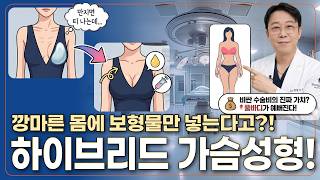 5:38 Hybrid breast augmentation: pros, cons and the effect of implant + fat (Korean) Dr. Park's channel · 2026.03.17
-
 7:25 No implant, unsure about fat? All about BiVOL (Korean) Dr. Park's channel · 2025.12.29
Frequently asked questions (FAQ)
Are the implant and fat grafting done at the same time in hybrid breast augmentation?
Yes. An implant creates the base volume while your own fat is grafted where needed in the same operation. The implant provides central volume and the fat adds tissue thickness and contour.
Will the implant be less palpable with hybrid breast augmentation?
Adding your own fat where the skin is thin can reinforce the soft tissue over the implant. However, results depend on fat survival, existing tissue thickness and implant position, so it cannot be said that the implant will never be felt.
Does all the grafted fat remain?
No. Some grafted fat may be absorbed. Fat survival varies with graft volume, technique and tissue condition, so a single survival rate cannot be applied to everyone.
Is hybrid better than implant-only augmentation?
Not for everyone. If existing tissue is ample, an implant alone may be planned; if the skin is thin or the contour around the implant needs extra refinement, a hybrid approach can be considered.
Can breast asymmetry be adjusted with fat grafting?
Depending on left–right differences in the breasts or chest wall, different amounts of fat can be grafted in specific areas to fine-tune the contour. Depending on the cause and degree of asymmetry, other factors such as implant size or position may also need adjusting.
📖 References
Click a [number] in the text to jump to its source, and ↩ to return. Only papers whose title, journal and year were verified on PubMed are listed.
- ↩ Salibian AA, Frey JD, Bekisz JM, Choi M, Karp NS. Fat Grafting and Breast Augmentation: A Systematic Review of Primary Composite Augmentation. Plast Reconstr Surg Glob Open. 2019;7(7):e2340.PMID 31942362 · DOI— Primary composite augmentation, 5 studies · 382 patients — average 109 mL fat, reoperation 3.7%
- ↩ Munhoz AM, de Azevedo Marques Neto A, Maximiliano J. Optimizing Surgical Outcomes with Small-Volume Silicone Implants Associated with Autogenous Fat Grafting in Primary and Revision Breast Augmentation Surgery: Soft Weight Hybrid (SWEH) Concept. Aesthetic Plast Surg. 2022;46(3):1087-1103.PMID 34850252 · DOI— Small implants + fat in slim patients — narrower gap between breasts, volume maintained at 12 months
BongBong Plastic Surgery · Dr. Park Seong-Soo, Medical Director
Contact us for a consultation