When muscles stay tight for a long time, movement decreases and local circulation drops too. Energy therapy is an approach that combines physical stimuli for this condition to help with pain management and creating an environment for recovery. It is not one standard procedure; the type and intensity vary with which tissue is in what condition right now.
Contents
What exactly is energy therapy?
Energy therapy is not a single device or standardized procedure, but a care program that combines several kinds of physical energy to suit your condition.
- Types of physical energy: ultrasound (sound waves), radiofrequency (electrical energy and heat), shockwave (strong acoustic waves)
- Manual therapy: the clinician directly checks muscle and joint movement and tension and applies physical stimulation
- Combination principle: only what is needed is chosen after checking the pain's location, cause, tissue condition and joint movement
The key is not delivering a lot of strong energy, but choosing the stimulus that suits this tissue right now.[1]
How do ultrasound, radiofrequency, shockwave and manual therapy differ?
| Method | Principle | Main uses |
|---|---|---|
| Ultrasound | High-frequency sound energy that people cannot hear | Pain management · supporting tissue recovery |
| Radiofrequency | Electrical energy → physical stimulation and heat response | Managing discomfort around muscles and joints · rehabilitation |
| Shockwave | Delivers strong acoustic waves to the target area | Musculoskeletal pain such as plantar fascia and tendons · stimulating tissue recovery |
| Manual therapy | The clinician's hands directly stimulate and guide movement | Restoring movement and function · alongside device treatment |
Device treatment and manual therapy are complementary, not substitutes for each other. They can be used together depending on your condition.[2]
Related readingIf your legs often swell, the criteria for telling lifestyle factors from signs of disease are covered in "Leg swelling and numb hands and feet: what to check before negative-pressure circulation care?".
Does it really help with tight muscles and circulation?
Sitting for long periods or repeating the same movements easily causes recurring muscle tension in the neck, shoulders, lower back, buttocks and calves.
- Some physical therapies can affect tissue temperature and microcirculation.
- For shockwave, studies on muscle microcirculation and tissue recovery have been reported.[3]
- A stimulus suited to the condition can help reduce tension and improve movement.
Note: the phrase "flushes toxins out of the body" does not accurately describe any medically confirmed action. It is more accurate to understand energy therapy not as a procedure that removes toxic substances, but as supportive treatment that manages tension, pain and reduced movement in muscles and soft tissue and creates an environment for recovery.
A systematic review of 8 studies (143 people) applying shockwave to muscle injuries reported reduced pain and improved function. However, the researchers added that higher-quality studies are needed to confirm the effect.[3]
When can it be considered?
| This condition | What to check first |
|---|---|
| Neck and shoulders often stiff from staying in the same posture for a long time | Check posture and lifestyle factors too |
| Ongoing discomfort in a specific muscle or tendon after exercise or repetitive work | Overuse; rule out tendinitis |
| Recurring muscle tension around the lower back and pelvis | Distinguish whether it is a muscle, joint or nerve problem |
| Slow recovery after exercise or a heavy overuse burden | Identify the cause of poor recovery |
| The rehabilitation stage of restoring movement and function after musculoskeletal treatment | Check previous treatment history and goals |
Even the same shoulder or back pain is approached differently depending on whether it is a muscle, tendon, ligament, joint or nerve problem. Don't decide the type from symptoms alone; identify the cause first.
No device is always better, either. When 28 randomized controlled trials with 1,460 patients with musculoskeletal conditions were pooled and analyzed, shockwave and laser treatment did not differ in pain, strength or range of motion.[4]
Common myths and facts — energy therapy
| What many people think… | What the evidence shows |
|---|---|
| "The stronger, the better." | Intensity and method must be adjusted to the area, the tissue condition and the characteristics of the device. |
| "It flushes out toxins from the body." | This does not accurately describe any medically confirmed action. The real purpose is managing tension, pain and movement and creating an environment for recovery. |
| "It regenerates all your cells." | It is hard to claim that energy-based treatment alone restores all tissue damage. Exercise therapy and activity adjustment are also needed. |
| "The same method works for every area." | Some guidelines note that certain electrical and ultrasound treatments have limited evidence of effect for specific conditions. Diagnosis comes first. |
What must be checked before treatment
- Pain location, duration and change with movement — understanding the symptoms
- Assessing muscle and joint condition — approach after differential diagnosis
- Ruling out warning signs — sudden severe pain, loss of strength, abnormal sensation, marked swelling or redness, persistent pain after injury
- Checking the device used and the purpose of treatment — don't expect just one effect such as "it improves blood circulation"
- Whether other rehabilitation is needed alongside — exercise therapy, activity adjustment and so on
If there are warning signs, the principle is not to assume it is just tight muscles but to check first for the possibility of another condition.
What I stress most often in the clinic about energy therapy is "look first at what this tissue needs now, not which device to use or how strongly." Even the same shoulder pain needs a completely different approach depending on whether it is a muscle knot, tendinitis, frozen shoulder or a nerve problem. At BongBong Plastic Surgery Wellness, we see energy therapy not as a standalone procedure but as cause assessment → combination design → reassessment.[4]
Energy therapy is a musculoskeletal care program that combines ultrasound, radiofrequency, shockwave and manual therapy to suit your condition. Choosing what matches the cause, more than intensity, determines the result.
🔬 Supporting research
Peer-reviewed international journal articles that support this article. Click a title to open the PubMed abstract.
- Cureus 2023 — systematic review, 8 studies · 143 people The Role of Extracorporeal Shock Wave Therapy in the Treatment of Muscle Injuries: A Systematic Review. Key finding: improved pain and function reported with shockwave for muscle injuries — level of evidence still limited In text [3] · PMID 37767244 · DOI
- Lasers in Medical Science 2025 — meta-analysis of 28 RCTs · 1,460 patients Extracorporeal Shock Wave Therapy versus laser therapy in treating musculoskeletal disorders: a systematic review and meta-analysis. Key finding: no difference between shockwave and laser in pain, strength or range of motion — assessing the condition comes before the device In text [4] · PMID 40232318 · DOI
🎬 Watch — Dr. Park Seong-Soo · BongBong Plastic Surgery
Related videos from BongBong Plastic Surgery's official channel and Dr. Park Seong-Soo's channel. Videos are in Korean and play on YouTube.
-
 0:55 Extracorporeal shockwave regenerative therapy: smart anti-aging that wakes up dormant cells (Korean) (Korean) Dr. Park's channel · 2026.03.27
-
 0:47 In pain the day before a golf game? How extracorporeal shockwave eases the pain (Korean) (Korean) Dr. Park's channel · 2026.07.04
-
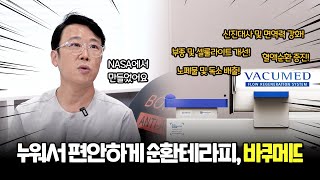 3:25 Anti-aging while lying down comfortably! Circulation therapy "Vacumed" (Korean) (Korean) Dr. Park's channel · 2024.10.15
Frequently asked questions (FAQ)
Is energy therapy different from regular physical therapy?
Energy therapy itself is not a name for any one specific treatment. Which devices (electrical, ultrasound, shockwave, heat) and methods are used determines what it actually involves.
If a muscle is injured, can energy therapy alone make it recover?
Tissue recovery is influenced by many factors, including the extent and cause of the injury, activity level, strength and joint function. It is hard to claim that energy-based treatment alone restores all injuries, and exercise therapy and activity adjustment can be considered alongside.
Is it better to treat with stronger energy when the pain is more severe?
Not necessarily. Intensity and method are adjusted by looking at not only the degree of pain but also the area, tissue condition and device characteristics.
Can it be used for back, shoulder and knee pain alike?
Even pain in the same area can have different causes, so the same method is not applied.
What should be checked first before treatment?
The first step is assessing which structure and cause the pain comes from. Next, the purpose of treatment, the device used and whether other rehabilitation is needed are checked with the clinician.
📖 References
Click a [number] in the text to jump to its source, and ↩ to return. Only papers whose title, journal and year were verified on PubMed are listed.
- ↩ Aiyer R, Noori SA, Chang KV, et al. Therapeutic Ultrasound for Chronic Pain Management in Joints: A Systematic Review. Pain Med. 2020;21(7):1437-1448.PMID 31095336 · DOI— systematic review of therapeutic ultrasound RCTs — consider it as an adjunct to other treatment rather than on its own
- ↩ Simplicio CL, Purita J, Murrell W, Santos GS, Dos Santos RG, Lana JFSD. Extracorporeal shock wave therapy mechanisms in musculoskeletal regenerative medicine. J Clin Orthop Trauma. 2020;11(Suppl 3):S309-S318.PMID 32523286 · DOI— review of the mechanisms of tissue response to shockwave (angiogenesis, cell proliferation)
- ↩ Mazin Y, Lemos C, Paiva C, Amaral Oliveira L, Borges A, Lopes T. The Role of Extracorporeal Shock Wave Therapy in the Treatment of Muscle Injuries: A Systematic Review. Cureus. 2023;15(8):e44196.PMID 37767244 · DOI— systematic review of muscle injuries, 8 studies · 143 people — improved pain and function reported; higher-quality studies needed
- ↩ Ismail Hassan M, Shafiek Mustafa Saleh M, Hesham Sallam M, et al. Extracorporeal Shock Wave Therapy versus laser therapy in treating musculoskeletal disorders: a systematic review and meta-analysis. Lasers Med Sci. 2025;40(1):194.PMID 40232318 · DOI— meta-analysis of 28 RCTs · 1,460 patients — no difference in pain between shockwave and laser
BongBong Plastic Surgery · Dr. Park Seong-Soo, Medical Director
Contact us for a consultation