Postpartum changes to the belly should be broken down into three things: subcutaneous fat, stretched skin and diastasis recti. Fat can be reduced with diet and exercise, and abdominal strength restored with core exercise, but there is a limit to how far skin stretched during pregnancy can shrink back. This is where abdominoplasty becomes an option.
Contents
The real reason the belly sags even after losing weight
It's easy to sum up why your belly looks different after childbirth as simply "I gained weight," but in reality three structures need to be looked at together.
- Subcutaneous fat: can be reduced with diet and exercise
- Stretched skin: skin that stretched greatly during pregnancy does not shrink back with exercise
- Diastasis recti: the gap between the left and right rectus muscles has widened → the belly protrudes forward even with ab exercises
If your weight is back to pre-pregnancy levels but you can grab the lower-belly skin, it folds when you stand, or creases form around the navel, a structural problem of leftover excess skin needs to be checked first.[1]
Related readingIf skin was left over after losing weight quickly after childbirth, you also need to think about when to schedule surgery. Find out more in "I lost the weight after childbirth but my belly is the same — do I need abdominoplasty?" (Korean).
What exercise can fix vs what it can't
A 2025 meta-analysis of 65 studies (21,334 people) on exercise within a year after childbirth found that the gap between the rectus muscles narrowed more in those who did abdominal exercise (low certainty of evidence). In other words, the rectus gap and abdominal strength can be improved to some extent with exercise.[1]
| Exercise can do this | Exercise can't do this |
|---|---|
| Reducing body fat | Skin that is left over and sags |
| Strengthening the abdominal muscles | Restoring the elasticity of skin that has already stretched |
| Diastasis recti (functional improvement) | Cutting away and removing skin |
Conclusion: "I've lost the weight but my belly just sags" and "I have a lot of belly fat" are not the same problem.
However, evidence that exercise alone treats diastasis recti is still weak. A systematic review of 7 randomized controlled trials (381 people) concluded that the evidence for recommending any specific exercise program as a treatment is very low.[4]
What exactly does abdominoplasty correct?
Abdominoplasty is body-contouring surgery that removes excess skin and fat and sutures a widened abdominal wall (diastasis recti). It is different from a procedure that simply reduces belly fat.
- Skin removal: the stretched, leftover skin and tissue are cut away directly.
- Abdominal wall repair: if the rectus muscles have separated, the fascia is sutured to narrow the midline.
- Navel reshaping: the position and shape of the navel are refined too.
- Combined liposuction: can be done at the same time below heavily sagging areas, on the flanks and so on.
The incision is usually planned to sit within the bikini line.[2]
Related readingIf you want to know about the incision extent and recovery process of abdominoplasty, see "Sagging belly: what options are there when exercise doesn't work?" (Korean).
How do liposuction and abdominoplasty differ?
| Item | Abdominal liposuction | Abdominoplasty |
|---|---|---|
| Tissue removed | Subcutaneous fat | Excess skin + fatty tissue |
| Skin removal | Not done | Done |
| Diastasis recti | Not done | Abdominal wall repair can be done too |
| Core purpose | Reducing fat thickness | Correcting skin sagging, abdominal contour and the abdominal wall |
If sagging skin is the core issue, liposuction alone won't make that skin disappear. Liposuction removes fat; abdominoplasty removes skin.
Whether the abdominal wall repair lasts has been confirmed by long-term follow-up. When 12 women whose diastasis recti was corrected during abdominoplasty with non-absorbable sutures were followed with CT for 76–84 months, none had separated again, even though their weight rose by an average of 6.5 kg in that time.[3]
Common myths and facts — postpartum abdominoplasty
| What many people think… | What the evidence shows |
|---|---|
| "Dieting hard will fix the sagging too." | Fat decreases, but skin that has already stretched and an abdominal wall that has separated often do not recover. |
| "Liposuction alone will flatten the belly." | Removing only fat can actually make the skin look looser. |
| "Abdominoplasty leaves a big scar, so it's a burden." | The incision is usually planned within the bikini line, prioritizing a position that clothing can cover. |
| "You can't have abdominoplasty until a year after childbirth." | The timing is decided after weight and tissue condition have stabilized, also taking pregnancy plans into account.[3] |
| "Diastasis recti always needs surgery." | Postpartum diastasis recti can improve in gap and function with exercise. Surgery narrows it directly by suturing the abdominal wall fascia. |
What must be checked before surgery
- The extent of excess skin — how far it has stretched
- Whether there is diastasis recti — diagnosing the degree of separation
- Existing abdominal surgery scars — such as the position of a C-section scar
- Current weight change — is it stable?
- Smoking — affects recovery
- Future pregnancy plans — the abdominal wall and skin can stretch again with pregnancy
In particular, future pregnancy plans have a big influence on deciding the timing of surgery. Be sure to tell us in the in-person consultation.
What I check most often in postpartum abdominal consultations is "Is this belly a fat problem, a skin problem or an abdominal wall problem?" Especially in women several years after childbirth, remaining diastasis recti is often found, and in that case no amount of ab exercise improves the forward-protruding line. The order is to identify the structural cause, not the visible belly fat, first.[4]
A postpartum belly is the result of three causes together: fat, skin and the abdominal wall. Fat recovers with diet and strength with exercise, but stretched skin and a separated abdominal wall need to be corrected directly with abdominoplasty.
🔬 Supporting research
Peer-reviewed international journal articles that support this article. Click a title to open the PubMed abstract.
- British Journal of Sports Medicine 2025 — meta-analysis, 65 studies · 21,334 people Impact of postpartum exercise on pelvic floor disorders and diastasis recti abdominis: a systematic review and meta-analysis. Key finding: postpartum abdominal exercise narrows the rectus gap, but certainty of evidence is low In text [1] · PMID 39694630 · DOI
- Plastic and Reconstructive Surgery 2005 — long-term CT follow-up, 12 women · 76–84 months Long-term follow-up of correction of rectus diastasis. Key finding: no recurrence after diastasis recti repair, even with weight gain In text [3] · PMID 15861083 · DOI
🎬 Watch — Dr. Park Seong-Soo · BongBong Plastic Surgery
Related videos from BongBong Plastic Surgery's official channel and Dr. Park Seong-Soo's channel. Videos are in Korean and play on YouTube.
-
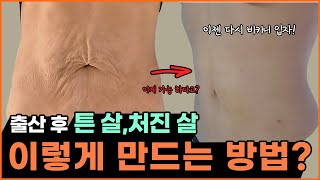 7:56 From removing postpartum stretch marks to firming a sagging belly when exercise doesn't work! (Korean) (Korean) Dr. Park's channel · 2025.02.19
-
 1:01 The criteria and effects of abdominoplasty — and pregnancy? (Korean) (Korean) BongBong official · 2021.10.08
-
 0:37 What's the difference between abdominoplasty and mini abdominoplasty? (Korean) (Korean) BongBong official · 2021.10.29
-
 0:50 Why and how long to wear an abdominal binder after abdominoplasty (Korean) (Korean) BongBong official · 2021.11.01
Frequently asked questions (FAQ)
Can stretched belly skin become firm again with exercise?
No. Exercise helps improve body fat, abdominal muscles and diastasis recti, but it cannot remove skin that is left over and folds. Abdominoplasty is what directly removes the excess skin.
Will liposuction alone get rid of the sagging skin too?
No. Liposuction is surgery that removes subcutaneous fat. It does not include removing stretched skin or suturing diastasis recti.
If I have diastasis recti, do I definitely need surgery?
No. Postpartum diastasis recti can improve in gap and function through exercise. When it is corrected surgically in abdominoplasty, the separated abdominal wall fascia is sutured to narrow it directly.
Is the abdominoplasty scar very noticeable?
The incision position is usually planned within the bikini line. A position that clothing can cover is prioritized, but no surgery leaves no scar.
Can it help even several years after childbirth?
Yes. Even after time has passed, if stretched skin or a separated abdominal wall remains, abdominoplasty can help. However, if you plan to become pregnant, the timing needs to be discussed.
📖 References
Click a [number] in the text to jump to its source, and ↩ to return. Only papers whose title, journal and year were verified on PubMed are listed.
- ↩ Beamish NF, Davenport MH, Ali MU, et al. Impact of postpartum exercise on pelvic floor disorders and diastasis recti abdominis: a systematic review and meta-analysis. Br J Sports Med. 2025;59(8):562-575.PMID 39694630 · DOI— meta-analysis of 65 postpartum exercise studies, 21,334 people — abdominal exercise reduced the gap between the rectus muscles (low certainty)
- ↩ Vidal P, Berner JE, Will PA. Managing Complications in Abdominoplasty: A Literature Review. Arch Plast Surg. 2017;44(5):457-468.PMID 28946731 · DOI— literature review of abdominoplasty complications — local complications 10–20%, systemic complications under 1%
- ↩ Nahas FX, Ferreira LM, Augusto SM, Ghelfond C. Long-term follow-up of correction of rectus diastasis. Plast Reconstr Surg. 2005;115(6):1736-41.PMID 15861083 · DOI— CT follow-up of 12 diastasis recti repairs — no recurrence even after 76–84 months
- ↩ Gluppe S, Engh ME, Bø K. What is the evidence for abdominal and pelvic floor muscle training to treat diastasis recti abdominis postpartum? A systematic review with meta-analysis. Braz J Phys Ther. 2021;25(6):664-675.PMID 34391661 · DOI— 7 RCTs, 381 people — very low evidence that specific exercises treat diastasis recti
BongBong Plastic Surgery · Dr. Park Seong-Soo, Medical Director
Contact us for a consultation