When considering breast augmentation, people care as much about whether the implant edge or feel will seem unnatural after surgery as about the size they want. Especially in slim bodies or when the breast tissue is thin, there is relatively little tissue covering the implant, so its outline can stand out. Hybrid breast augmentation secures the needed breast volume with an implant while using your own fat to supplement deficient soft tissue, so size and a natural line can be considered together. Why do breast implants look obvious?
Contents
Why do breast implants look obvious?
How natural an implant looks after breast augmentation is not determined only by which implant was chosen.
Even with the same implant, the visible result can differ depending on the amount of existing breast tissue, skin thickness, chest wall shape, and implant size and position.
Especially when breast tissue is thin, the soft tissue surrounding the implant is relatively lacking, so the implant outline can show in the upper or inner breast, or its edge can be felt.
And if you choose an implant that is large for your current body, you can secure the needed volume, but making the transition between existing breast tissue and the implant look natural becomes even more important.
| What to check | Possible effect on the breast line |
|---|---|
| Existing breast tissue | Thin tissue makes the implant outline relatively easier to see |
| Skin and soft-tissue thickness | Can affect how well the implant is covered |
| Implant size | The larger it is relative to the body, the more the connection with surrounding lines must be considered |
| Chest wall width | Affects implant width and overall breast proportions |
| Upper breast volume | If lacking, the upper implant edge can look relatively prominent |
So for natural breast augmentation, rather than simply choosing an implant type, it is important to also assess how well your breast can naturally cover an implant.
How does hybrid breast augmentation make the result more natural?
Hybrid breast augmentation uses an implant together with fat grafting.
Here, the role of fat is not only to make the breast bigger. After the implant secures the basic volume you want, your own fat can be used to supplement areas where the tissue covering the implant is relatively thin or where the outline tends to show.
For example, if the upper breast tissue is thin, fat can be used so the area where the implant meets the existing breast flows more smoothly; if the inner breast or a specific area lacks tissue, volume can be finely adjusted around the needed spot.
In other words, rather than creating every breast line with one implant, the implant handles the needed size and basic shape, while fat refines the detailed contour around the implant.
Because it uses your own fat, a feature of the hybrid approach is that it blends with existing breast tissue and can be used to plan a softer feel and more natural breast contour.
In a systematic review of 382 patients who had implants and fat together as a primary surgery, an average of 109 mL of fat per breast was placed mainly along the inner breast boundary, and the reoperation rate was 3.7%.[1]
Related readingHow hybrid augmentation fills what an implant alone cannot is covered in "Where implants fall short: how does hybrid breast augmentation fill the gaps?" (Korean).
How should the design differ for a slim body?
When considering breast augmentation with a slim body, it is important to check how much breast tissue you currently have relative to the size you want.
If body fat is low and the breast skin and soft tissue are thin, there may also be relatively little tissue to cover the implant.
In such cases, rather than automatically choosing a small implant, the implant size and shape can be decided considering chest wall width and breast tissue thickness, with fat used where extra tissue support is needed.
However, because hybrid breast augmentation includes fat grafting, you also need to check how much fat can actually be harvested from the abdomen, flanks or thighs.
Rather than assuming a hybrid approach is difficult just because you are slim, it is better to look at the amount of fat available and the extent of supplementation needed together.
Ultimately, hybrid breast augmentation for slim bodies should be designed not around "how big can it go?" but around how to create the desired volume while your current tissue covers the implant naturally.
In a study of slim patients (average BMI 19.3) who had small implants (average 180 cc) plus fat (average 125 cc per breast), the gap between the breasts narrowed from 31.8 mm to 20.9 mm, and there was no significant difference in volume between 3 and 12 months.[2]
What should be checked for a natural result?
What matters in hybrid breast augmentation is not putting in a lot of fat but accurately identifying where fat is needed.
Because skin and breast tissue thickness differ from person to person, rather than supplementing the whole implant evenly, the fat grafting range can be planned by identifying areas with relatively little tissue, such as the upper breast, inner breast or implant edge.
Also, part of the grafted fat settles during recovery and part may be absorbed. So rather than designing based only on the volume right after surgery, it is necessary to consider how the implant and existing breast tissue will connect after recovery.
Checking not only current breast tissue and skin thickness but also chest wall width, the desired breast size and projection, left–right differences and the amount of fat available allows a surgical plan better tailored to your body.
The core of hybrid breast augmentation is not simply adding an implant and fat grafting, but using your own fat to supplement the soft tissue an implant alone may lack,
creating a naturally connected overall breast contour.
Hybrid breast augmentation: common myths and facts
| What many people think… | What the evidence shows |
|---|---|
| "Implants look obvious because they are too big." | The thickness of covering tissue and chest wall proportions matter more than size. |
| "A small implant always looks natural." | With thin tissue, even a small implant's edge can show. |
| "Just adding fat makes the implant undetectable." | Fat only softens the edges; placement plane and size design come first. |
For patients worried about "obvious-looking breasts," I examine both lying down and standing. If the upper implant edge shows when lying down, it signals that tissue thickness needs supplementing.
When considering breast augmentation, people care as much about whether the implant edge or feel will seem unnatural after surgery as about the size they want. Especially in slim bodies or when the breast tissue is thin, there is relatively little tissue covering the implant, so its outline can stand out.
🔬 Supporting research
Peer-reviewed international journal articles that support this article. Click a title to open the PubMed abstract.
- Plastic and Reconstructive Surgery Global Open 2019 — primary combined breast augmentation, 5 studies · 382 patients Fat Grafting and Breast Augmentation: A Systematic Review of Primary Composite Augmentation. Key finding: average 109 mL fat, reoperation 3.7% In text [1] · PMID 31942362 · DOI
- Aesthetic plastic surgery 2022 — slim body, small implant + fat Optimizing Surgical Outcomes with Small-Volume Silicone Implants Associated with Autogenous Fat Grafting in Primary and Revision Breast Augmentation Surgery: Soft Weight Hybrid (SWEH) Concept. Key finding: gap between breasts 31.8→20.9 mm, volume maintained at 12 months In text [2] · PMID 34850252 · DOI
🎬 Watch — Dr. Park Seong-Soo · BongBong Plastic Surgery
Related videos from BongBong Plastic Surgery's official channel and Dr. Park Seong-Soo's channel. Videos are in Korean and play on YouTube.
-
 0:42 Why breast implants look obvious and how to fix it (feat. hybrid breast augmentation) (Korean) Dr. Park's channel · 2026.08.21
-
 8:00 What is hybrid breast augmentation? Combining the strengths of implants and fat grafting (Korean) Dr. Park's channel · 2026.08.19
-
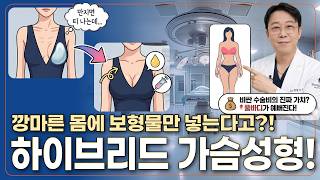 5:38 Hybrid breast augmentation: pros, cons and the effect of implant + fat (Korean) Dr. Park's channel · 2026.03.17
Frequently asked questions (FAQ)
Can breast implants look more obvious in slim people?
If breast tissue and skin are thin, there is relatively little soft tissue covering the implant, so the outline can show more easily. However, the actual result depends on body type and implant size and position, so the current tissue condition should be checked first.
After hybrid breast augmentation, can the implant not be felt at all?
Using fat does not guarantee that the implant's presence disappears completely. The goal is to supplement areas lacking tissue so the implant and existing breast tissue connect more naturally.
Is fat grafted into the whole breast?
Not necessarily evenly into the whole breast. Depending on the current breast, it can be planned around areas that need extra soft tissue, such as the upper breast, inner breast or implant edge.
I'm slim and don't have much fat — is it still possible?
First check how much fat can be harvested from the abdomen, flanks or thighs. Comparing the fat needed with the amount actually available determines how far the hybrid approach can be applied.
What is the biggest difference from implants alone?
Implant breast augmentation creates breast size and shape centered on the implant. Hybrid breast augmentation additionally uses your own fat to supplement areas where tissue is thin or fine contour adjustment is needed.
📖 References
Click a [number] in the text to jump to its source, and ↩ to return. Only papers whose title, journal and year were verified on PubMed are listed.
- ↩ Salibian AA, Frey JD, Bekisz JM, Choi M, Karp NS. Fat Grafting and Breast Augmentation: A Systematic Review of Primary Composite Augmentation. Plast Reconstr Surg Glob Open. 2019;7(7):e2340.PMID 31942362 · DOI— primary combined breast augmentation, 5 studies · 382 patients — average 109 mL fat, reoperation 3.7%
- ↩ Munhoz AM, de Azevedo Marques Neto A, Maximiliano J. Optimizing Surgical Outcomes with Small-Volume Silicone Implants Associated with Autogenous Fat Grafting in Primary and Revision Breast Augmentation Surgery: Soft Weight Hybrid (SWEH) Concept. Aesthetic Plast Surg. 2022;46(3):1087-1103.PMID 34850252 · DOI— slim body, small implant + fat — gap between breasts 31.8→20.9 mm, volume maintained at 12 months
BongBong Plastic Surgery · Dr. Park Seong-Soo, Medical Director
Contact us for a consultation