Hybrid breast augmentation (composite breast augmentation) uses an implant for overall size and central volume, and fat to refine the inner breast, upper breast, implant edges and left–right differences. Cleavage is not created the same way just by placing the implant further inward, so the needed volume is decided based on chest wall width and the original gap between the breasts.
Contents
How does hybrid breast augmentation work?
It is breast augmentation that uses an implant together with fat, called composite breast augmentation in the literature. The key is not using both methods at once but dividing their roles.
| Area | What the implant handles | What fat refines |
|---|---|---|
| Overall volume | Desired size and central volume | Detailed volume where needed |
| Upper breast | Volume according to implant shape | Fine adjustment of the upper line |
| Cleavage | Influenced by position and chest wall structure | Refines the inner breast line |
| Implant edges | Outline shows if tissue is thin | Supplements the thickness of covering tissue |
| Left–right differences | Adjusted by size and position | Different amounts of fat for each area |
Related readingHow hybrid augmentation refines edges and show-through that an implant alone can't fix is covered in "Where implants fall short: how does hybrid breast augmentation fill the gaps?" (Korean).
Why are cleavage and the upper breast hard to achieve with an implant alone?
Cleavage depends heavily on chest wall width and the gap between the two breasts. Making the implant bigger or placing it further inward has limits, and in bodies with thin tissue the implant edge can show or be felt. In a systematic review of 382 patients who had composite breast augmentation as a primary surgery, an average of 109 mL of fat was placed per breast, and the most common site was the inner breast and cleavage (in 80% of studies).[1]
In a study of slim patients (average BMI 19.3) who had small implants (average 180 cc) with fat (average 125 cc per breast), the gap between the breasts narrowed from an average of 31.8 mm before surgery to 20.9 mm at 12 months, and there was no significant difference in breast volume between 3 and 12 months.[2]
How is hybrid breast augmentation designed?
Rather than deciding only the desired size, we first check the current breast, chest wall and tissue thickness.
- Current breast size and tissue volume
- Chest wall width and overall body proportions
- Desired breast size and projection
- Volume of the upper and inner breast
- Left–right differences in size and shape
- Thickness of the skin and soft tissue covering the implant
- Amount of fat that can be harvested from the abdomen and thighs
Hybrid design is less about the amounts of implant and fat and more about deciding "which area each one handles."
Does all the grafted fat remain?
Grafted fat goes through a settling process (take), so not all of what is placed remains. Because the proportion that remains varies by person and technique, planning is based on the volume and line after recovery, not the appearance right after surgery. Fat is not concentrated in one spot but placed in several layers.
Common myths and facts — cleavage and the upper breast
| What many people think… | What the evidence shows |
|---|---|
| "A bigger implant creates cleavage." | Cleavage is strongly influenced by chest wall width and the gap between the breasts, so size alone does not create it. |
| "The more fat you put in, the fuller the upper breast." | Considering fat take, it is important to place an appropriate amount where needed, divided up. |
| "Left–right differences are matched only by implant size." | In addition to adjusting the implant, different amounts of fat for each area can be planned. |
| "Hybrid is impossible for slim bodies." | Roles are decided after checking the covering tissue thickness and the amount of fat that can actually be harvested. |
Related readingWhy hybrid is considered for slim bodies is covered in "Breast augmentation for slim bodies: why is hybrid said to be good?" (Korean).
What should be checked for a natural line?
When breast tissue is thin, the implant outline is relatively visible, so we plan a smoothly connected line by supplementing the surrounding tissue volume. For cleavage, the needed inner volume is decided based on the original body, and after surgery fat take and implant position are managed together.
Capsular contracture arising from the implant itself is a problem that must be managed separately from fat. A meta-analysis of 13 studies (5,440 patients) found that capsular contracture rates differed by implant surface type.[3]
For patients who want cleavage, I first measure the gap between the breasts with a ruler and show them. In a chest wall with a wide gap, simply enlarging the implant tends to create a shape that spreads sideways instead of cleavage. The chest wall sets the gap; filling the space between is the role of fat.
Hybrid breast augmentation designs the breast by dividing roles: the implant for central volume, and fat for cleavage, the upper breast and implant edges. Rather than size, a division of roles matched to the chest wall and tissue thickness creates a natural line.
🔬 Supporting research
Peer-reviewed international journal articles that support this article. Click a title to open the PubMed abstract.
- Plastic and Reconstructive Surgery Global Open 2019 — systematic review, 5 studies · 382 patients Fat Grafting and Breast Augmentation: A Systematic Review of Primary Composite Augmentation. Key finding: average 109 mL fat, mainly inner breast and cleavage — reoperation 3.7% In text [1] · PMID 31942362 · DOI
- Aesthetic plastic surgery 2022 — case series · 12-month follow-up Optimizing Surgical Outcomes with Small-Volume Silicone Implants Associated with Autogenous Fat Grafting in Primary and Revision Breast Augmentation Surgery: Soft Weight Hybrid (SWEH) Concept. Key finding: gap between breasts 31.8 → 20.9 mm, volume maintained at 12 months In text [2] · PMID 34850252 · DOI
🎬 Watch — Dr. Park Seong-Soo · BongBong Plastic Surgery
Related videos from BongBong Plastic Surgery's official channel and Dr. Park Seong-Soo's channel. Videos are in Korean and play on YouTube.
-
 8:00 What is hybrid breast augmentation? Combining the strengths of implants and fat grafting (Korean) Dr. Park's channel · 2026.08.19
-
 5:38 Hybrid breast augmentation: pros, cons and the effect of implant + fat (Korean) Dr. Park's channel · 2026.03.17
-
 0:38 Who should get hybrid breast augmentation: only these cases! (revision, thin skin) (Korean) Dr. Park's channel · 2026.08.23
-
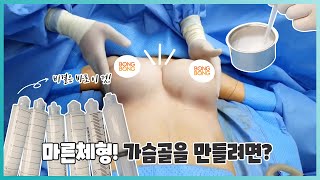 1:50 How can slim people get cleavage? (Korean) BongBong official · 2020.10.20
Frequently asked questions (FAQ)
How is it different from regular breast augmentation?
Regular implant breast augmentation plans volume and shape around the implant, while hybrid adds fat to finely adjust the upper breast, inner breast and contour around the implant.
Is it possible for slim bodies?
The roles of implant and fat are planned after checking the thickness of the tissue covering the breast and the amount of fat that can actually be harvested.
Can hybrid also improve cleavage?
Fat can be used in the inner breast to refine the contour around the cleavage. However, what is possible depends on chest wall width and the gap between the breasts.
If my breasts differ in size, is the amount of fat different too?
If tissue volume or upper-pole volume differs between sides, the fat grafting plan can be varied by area.
Does all the grafted fat remain?
Because it goes through a take process, not all of what is placed remains. Planning takes into account volume changes after recovery.
📖 References
Click a [number] in the text to jump to its source, and ↩ to return. Only papers whose title, journal and year were verified on PubMed are listed.
- ↩ Salibian AA, Frey JD, Bekisz JM, Choi M, Karp NS. Fat Grafting and Breast Augmentation: A Systematic Review of Primary Composite Augmentation. Plast Reconstr Surg Glob Open. 2019;7(7):e2340.PMID 31942362 · DOI— primary composite breast augmentation, 5 studies · 382 patients — average 109 mL fat, mainly in the inner breast and cleavage
- ↩ Munhoz AM, de Azevedo Marques Neto A, Maximiliano J. Optimizing Surgical Outcomes with Small-Volume Silicone Implants Associated with Autogenous Fat Grafting in Primary and Revision Breast Augmentation Surgery: Soft Weight Hybrid (SWEH) Concept. Aesthetic Plast Surg. 2022;46(3):1087-1103.PMID 34850252 · DOI— slim body, small implant + fat — gap between breasts 31.8 mm → 20.9 mm, volume maintained at 12 months
- ↩ Zhai P, Wu Y, Yang D, Ma W, Zhai Y, Xie H. A systematic review and meta-analysis of capsular contracture rate after breast augmentation with textured and smooth breast prostheses. Gland Surg. 2022;11(1):166-174.PMID 35242678 · DOI— meta-analysis, 13 studies · 5,440 patients — capsular contracture rate differs by implant surface
BongBong Plastic Surgery · Dr. Park Seong-Soo, Medical Director
Contact us for a consultation