Not all breast augmentation is done the same way. It can broadly be divided into implants, fat grafting, hybrid, BiVOL and Bounce hybrid, and each differs in how it creates volume and how it approaches feel, contour and tissue reinforcement. Recently, rather than using a single method, approaches that combine implants, fat and biomaterials to create the desired breast shape and a natural contour are also being used.
Contents
- How do the five breast augmentation methods differ?
- What is implant breast augmentation?
- What is fat grafting breast augmentation?
- What is hybrid breast augmentation?
- What is BiVOL breast augmentation?
- What is Bounce hybrid breast augmentation?
- The five methods compared at a glance
- Which breast augmentation method is right for me?
- Breast augmentation: common myths and facts
How do the five breast augmentation methods differ?
The biggest difference between methods lies in what creates the breast volume and how missing tissue is compensated. Implants use an implant of a set shape and size to create the overall volume and shape. Fat grafting harvests fat from the abdomen or thighs and injects it into the breast, using your own tissue without an artificial implant. Hybrid uses an implant and fat together, combining the volume an implant provides with the natural outline fat provides. BiVOL uses biomaterials such as ADM (acellular dermal matrix) instead of an implant to create volume and an environment where tissue can settle. Bounce hybrid is a combined method that uses an implant, BiVOL and fat at once, assigning each a different role.
In a meta-analysis of 13 studies (5,440 patients) comparing implant surfaces, the rate of capsular contracture differed by surface type.[1]
What is implant breast augmentation?
Implant breast augmentation is the most common method: a silicone gel or other breast implant is placed to create the desired volume and shape. It is advantageous when you want to increase breast size fairly definitely. Because the implant type, size and shape can be chosen to plan volume and projection, it is easy to set a specific target size. It is also better suited than fat alone to creating a large overall volume. On the other hand, because an implant is used, implant-related care is needed. Regular check-ups after surgery are important, and follow-up methods may differ by product.
In a systematic review of 22 studies (3,565 patients) on cosmetic breast fat grafting, the average fat retention was 62.4%, and complications occurred in 17.2%, similar to implant augmentation.[2]
What is fat grafting breast augmentation?
Fat grafting breast augmentation harvests fat from your own body and grafts it into the breast. Because fat is taken from areas such as the abdomen or thighs, it can increase breast volume while contouring fatty areas. Since it uses your own fat, the way it creates feel and shape differs from implant placement. It is particularly useful where a natural transition of volume is needed, such as the upper pole or outer breast. However, not all grafted fat is retained. Some fat may be absorbed, so there is a limit to the volume a single session can create, and additional sessions are sometimes considered.
In a systematic review of 382 patients who had implants and fat together as a primary surgery, the reoperation rate was 3.7%, and the most common reason was additional fat grafting.[3]
Related readingHow hybrid augmentation designs cleavage and the upper pole is covered in "Hybrid breast augmentation: can cleavage and the upper breast line be designed too?" (Korean).
Related readingIf you are concerned about both sagging and volume after your 40s, see "Can women in their 40s have breast augmentation?" (Korean).
What is hybrid breast augmentation?
Hybrid breast augmentation uses an implant together with fat. The implant creates the basic size and overall volume, while fat is grafted around the implant and into the upper and outer breast to create a softer contour. Its biggest advantage is using both methods together. Compared with an implant alone, fat can refine the boundary areas; compared with fat alone, the desired volume is easier to secure reliably. It is especially useful for slim bodies or thin breast skin where you want to reduce visible implant outline, creating a natural outline with both implant and fat. Hybrid breast augmentation has become established as a method combining implants with fat.
What is BiVOL breast augmentation?
BiVOL combines "Bio-compatible" and "Volumizer" and is a breast augmentation method using biomaterials such as acellular dermal matrix (ADM). Rather than placing a silicone implant to create volume like conventional augmentation, its core is using the way the grafted biomaterial settles and remodels within tissue to create volume and an environment where your own tissue can form. Unlike implant-centered augmentation, BiVOL does not use a silicone implant. It also aims to design the needed volume where you want it, in a form that connects naturally with existing tissue. However, because its surgical principle differs from conventional silicone implant augmentation, it is more accurate to understand it as a method that reinforces tissue and creates volume with ADM, rather than simply "implant-free breast augmentation."
What is Bounce hybrid breast augmentation?
Bounce hybrid breast augmentation uses a Bounce breast implant + BiVOL + fat in a single procedure. It is a recently introduced combined hybrid method in which the three materials are not used for the same purpose but each takes on a different role. The implant plays the central role in creating the base volume and shape of the whole breast. BiVOL is used to reinforce the soft tissue around the implant and help tissue settle stably. Fat can be used to smoothly connect the boundary where the implant meets existing breast tissue and to refine the upper and outer contour. In short, the key is dividing roles: implant for volume, BiVOL for tissue reinforcement, and fat for contour and feel. Whereas conventional hybrid combines implants and fat, Bounce hybrid adds BiVOL and also considers the tissue environment.
The five methods compared at a glance
| Method | Main components | Key feature | Advantage |
|---|---|---|---|
| Implant | Breast implant | Creates volume directly with an implant | Easy to plan the desired size and shape |
| Fat grafting | Your own fat | Grafts your own fat | Natural feel and body contouring |
| Hybrid | Implant + fat | Uses both methods together | Designs volume and a natural contour together |
| BiVOL | Biomaterials such as ADM | Creates a tissue-regenerating environment and volume without an implant | Aims for tissue reinforcement and volume without an implant |
| Bounce hybrid | Implant + BiVOL + fat | Uses three methods by role | Designs volume, tissue reinforcement and contour together |
Which breast augmentation method is right for me?
When choosing a method, it is not just about "how many cup sizes do I want to go up?" You need to look at current breast size, skin thickness, fat, degree of sagging, chest wall shape, left–right asymmetry, and the volume and feel you want. If clearly increasing volume matters most, implants can be used; if you want natural volume without an artificial implant, fat grafting or BiVOL can be considered. If you want both the reliable volume of an implant and the natural contour of fat, hybrid can be used; and if you want to design the overall breast shape by combining implant, BiVOL and fat in different roles, Bounce hybrid can be considered.
Breast augmentation: common myths and facts
| What many people think… | What the evidence shows |
|---|---|
| "The most famous method is the best method." | The right method differs by tissue thickness, fat and desired size. |
| "Fat grafting has no side effects." | Fat necrosis and calcification can occur, so imaging follow-up is needed. |
| "Implants last a lifetime once placed." | Implants are not lifetime medical devices, so regular check-ups are needed. |
When choosing a method, I start by pinching the skin to gauge its thickness. The thinner the covering tissue, the more I consider adding fat or tissue reinforcement rather than an implant alone.
Breast augmentation is not just one operation of placing an implant. Implants give reliable volume, fat grafting gives a natural contour, hybrid combines the two, BiVOL uses ADM for tissue reinforcement and volume, and Bounce hybrid combines implant, BiVOL and fat according to their roles. So rather than comparing size alone, the key to breast design is choosing a method that considers the volume and feel you want along with your body and tissue.
🔬 Supporting research
Peer-reviewed international journal articles that support this article. Click a title to open the PubMed abstract.
- Gland surgery 2022 — meta-analysis, 13 studies · 5,440 patients A systematic review and meta-analysis of capsular contracture rate after breast augmentation with textured and smooth breast prostheses. Key finding: capsular contracture differs by implant surface In text [1] · PMID 35242678 · DOI
- Aesthetic surgery journal 2016 — cosmetic breast fat grafting, 22 studies · 3,565 patients Autologous Fat Grafting in Cosmetic Breast Augmentation: A Systematic Review on Radiological Safety, Complications, Volume Retention, and Patient/Surgeon Satisfaction. Key finding: average retention 62.4%, complications 17.2% In text [2] · PMID 27329661 · DOI
🎬 Watch — Dr. Park Seong-Soo · BongBong Plastic Surgery
Related videos from BongBong Plastic Surgery's official channel and Dr. Park Seong-Soo's channel. Videos are in Korean and play on YouTube.
-
 8:00 What is hybrid breast augmentation? Combining the strengths of implants and fat grafting (Korean) Dr. Park's channel · 2026.08.19
-
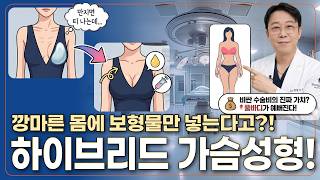 5:38 Hybrid breast augmentation: pros, cons and the effect of implant + fat (Korean) Dr. Park's channel · 2026.03.17
-
 5:00 Natural BiVOL breast augmentation: key points from Dr. Kang Min-gu (Korean) Dr. Park's channel · 2025.11.07
Frequently asked questions (FAQ)
What is the biggest difference between implants and fat grafting?
Implants create breast volume with an implant of a set shape and size, while fat grafting harvests your own fat and grafts it into the breast. Implants are better for clearly creating large volume, and fat grafting has advantages for a natural feel and outer contour.
How is hybrid breast augmentation different from implant surgery?
Hybrid does not use an implant alone; fat is grafted at the same time. The implant secures the base volume, while fat refines the contour around the implant and the outer breast.
Does BiVOL not use a silicone implant?
Correct. BiVOL does not place a silicone implant; it aims for tissue reinforcement and volume using biomaterials such as ADM.
How is Bounce hybrid different from conventional hybrid?
Conventional hybrid uses an implant with fat. Bounce hybrid adds BiVOL, designing implant, tissue reinforcement and contour each in a different way.
Is fat grafting the most natural breast augmentation?
Because fat grafting uses your own tissue, it has advantages for a natural feel and contour. But naturalness is not unique to fat grafting; combining methods — such as hybrid, adding fat to an implant — is also used to create natural boundaries.
📖 References
Click a [number] in the text to jump to its source, and ↩ to return. Only papers whose title, journal and year were verified on PubMed are listed.
- ↩ Zhai P, Wu Y, Yang D, Ma W, Zhai Y, Xie H. A systematic review and meta-analysis of capsular contracture rate after breast augmentation with textured and smooth breast prostheses. Gland Surg. 2022;11(1):166-174.PMID 35242678 · DOI— meta-analysis, 13 studies · 5,440 patients — capsular contracture differs by implant surface
- ↩ Groen JW, Negenborn VL, Twisk JW, Ket JC, Mullender MG, Smit JM. Autologous Fat Grafting in Cosmetic Breast Augmentation: A Systematic Review on Radiological Safety, Complications, Volume Retention, and Patient/Surgeon Satisfaction. Aesthet Surg J. 2016;36(9):993-1007.PMID 27329661 · DOI— cosmetic breast fat grafting, 22 studies · 3,565 patients — average retention 62.4%, complications 17.2%
- ↩ Salibian AA, Frey JD, Bekisz JM, Choi M, Karp NS. Fat Grafting and Breast Augmentation: A Systematic Review of Primary Composite Augmentation. Plast Reconstr Surg Glob Open. 2019;7(7):e2340.PMID 31942362 · DOI— primary combined breast augmentation, 5 studies · 382 patients — average 109 mL fat, reoperation 3.7%
BongBong Plastic Surgery · Dr. Park Seong-Soo, Medical Director
Contact us for a consultation