Unlike conventional breast augmentation, which creates volume by placing a silicone implant, BiVOL breast augmentation designs breast volume and shape without an implant, using acellular dermal matrix (ADM). ADM is a biomaterial made by removing the cellular components from human dermis while keeping the extracellular matrix (ECM), and it has been used in tissue reconstruction. BiVOL applies ADM to breast augmentation, aiming for the patient's own tissue to grow in and remodel it over time.
Contents
What is BiVOL breast augmentation?
BiVOL is a breast augmentation method that uses ADM (acellular dermal matrix) instead of a breast implant. Conventional augmentation typically chooses an implant's size and shape and places it in the breast to create the desired volume. BiVOL's core idea is designing breast volume and shape with the biomaterial ADM instead of an implant. Materials that develop and introduce BiVOL describe it as "fourth-generation breast augmentation," presenting volume design tailored to the individual's body and desired breast line, rather than fitting a standard implant size, as its main feature. "Implant-free" here should be understood as not using a silicone implant. BiVOL is not surgery in which nothing is placed; it uses the biomaterial ADM to create the tissue environment and volume.
Related readingThe basic concept of fourth-generation BiVOL was first introduced in "Is breast augmentation possible without implants? Fourth-generation BiVOL" (Korean).
What is the ADM used in BiVOL?
ADM stands for acellular dermal matrix, also called acellular allogeneic dermis. Simply put, it is a biomaterial made by removing the cellular components from human skin tissue and keeping the extracellular matrix (ECM) that supports tissue. ECM contains components that form tissue structure, such as collagen, elastin and fibronectin. ADM is not a new material that suddenly appeared; it has long been used in tissue reconstruction, including breast reconstruction. Research on ADM for tissue regeneration and soft-tissue defect repair has also continued in Korea. What sets ADM apart is that it is not just filler material. Once placed, ADM acts as a kind of supporting structure for tissue, and as the patient's cells grow into it, blood vessel formation and tissue remodeling can take place. In other words, it follows a tissue-integration concept different from "a material that stays exactly as placed."
ADM is a material mainly used in breast surgery for treating capsular contracture and for reconstruction. A meta-analysis of 9 studies (481 breasts) using ADM to treat capsular contracture reported low recurrence, but this is a result for treatment purposes; long-term evidence for creating volume with ADM alone is still limited.[1]
How is it different from conventional implant augmentation?
The biggest difference is the material and method used to create volume. Conventional implant augmentation designs the breast shape by choosing a manufactured implant's size, height, width and projection. So the implant's specifications, your breast tissue and chest wall structure strongly affect the result. BiVOL, by contrast, uses ADM without placing an implant, so it can emphasize individual design rather than deciding breast size by set implant specifications. In particular, two common concerns with implant augmentation are "feeling the implant" and "the implant outline showing through." Because BiVOL does not use a silicone implant at all, it can be designed to avoid feel and outline problems caused by silicone implants. However, using ADM does not mean the feel or shape will be exactly the same in every surgery. Skin thickness, existing tissue volume, chest wall structure, degree of sagging and the surgical design all affect the final result.
What is BiVOL's most distinctive feature?
People looking into BiVOL tend to focus on three main points.
Designing volume without an implant
BiVOL's defining feature is not using an implant. So instead of choosing an implant size, the needed volume can be designed based on the individual's body and breast shape.
Volume that changes along with tissue
ADM is not a material that simply fills space and stops there. It is a biomaterial into which cells migrate and blood vessels form, allowing tissue remodeling. Using this property, BiVOL aims for the patient's tissue to grow in over time and for ADM to integrate with and remodel into the tissue.
Natural design not dependent on an implant
For a natural result in breast augmentation, the proportion between chest wall and breast, upper and lower volume, left–right balance, and the thickness of skin and tissue matter more than simply increasing size. A feature of BiVOL is that it can design the volume each individual needs while reflecting these factors.
Who is BiVOL breast augmentation suitable for?
BiVOL may particularly interest people with the following concerns.
- Those who don't want an implant
- Those worried about implant foreign-body feel or visible outline
- Those who want volume tailored to their body rather than a standard implant size
- Those who value a natural feel and line
- Those looking for a method different from implant-centered augmentation
Especially for slim bodies or thin skin and soft tissue, where implant edges or outline are a worry, BiVOL's implant-free design can be one option. However, when other methods are needed to create enough volume and shape — such as when breast tissue is very scant or sagging is severe — it may be difficult to achieve the desired result with BiVOL alone. So it is important to choose the surgical method considering breast tissue volume, skin thickness, chest wall shape, degree of sagging and the desired size.
Recovery and care after BiVOL surgery
BiVOL is designed differently from conventional surgery that places a silicone implant through a large skin incision, with small incisions and a quick return to daily life presented as main features. However, recovery time should not be stated as "always a set number of days." Pain, swelling and bruising can occur depending on the extent of surgery, tissue condition and individual recovery. Right after surgery, follow the medical team's guidance on compression, posture, limiting arm movement and wound care, and if sudden severe pain, fever, marked swelling or skin color changes occur during recovery, contact the clinic that performed your surgery right away.
BiVOL breast augmentation: common myths and facts
| What many people think… | What the evidence shows |
|---|---|
| "BiVOL is a type of implant." | BiVOL is not a silicone implant; it uses ADM (acellular dermal matrix). |
| "No implant means no side effects." | Any surgery carries possible complications, and long-term follow-up evidence for BiVOL is still limited. |
| "You can create any size you want without limit." | There is a range of achievable volume depending on body type and tissue condition. |
In BiVOL consultations I ask specifically "why you don't want an implant." Whether it is concern about a foreign-body feel or a past revision experience decides whether BiVOL fits or another method is better.
BiVOL is a breast augmentation method that designs breast volume and shape using ADM (acellular dermal matrix) instead of placing a silicone implant. ADM is a biomaterial used in tissue reconstruction, including breast reconstruction, and has the property of allowing the patient's cells to grow in and the tissue to remodel in the body. BiVOL applies these properties of ADM to breast augmentation, aiming for tailored volume independent of implant size and natural tissue integration.
🔬 Supporting research
Peer-reviewed international journal articles that support this article. Click a title to open the PubMed abstract.
- Aesthetic surgery journal 2023 — meta-analysis of ADM for capsular contracture, 9 studies · 481 breasts Efficacy of Acellular Dermal Matrix Type in Treatment of Capsular Contracture in Breast Augmentation: A Systematic Review and Meta-Analysis. Key finding: low recurrence; evidence for prevention in primary surgery lacking In text [1] · PMID 37595294 · DOI
🎬 Watch — Dr. Park Seong-Soo · BongBong Plastic Surgery
Related videos from BongBong Plastic Surgery's official channel and Dr. Park Seong-Soo's channel. Videos are in Korean and play on YouTube.
-
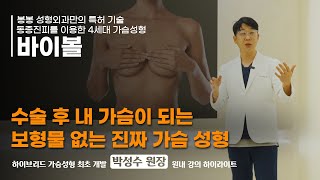 13:24 Implant-free BiVOL breast augmentation, explained on Dr. Park's channel (Korean) Dr. Park's channel · 2025.07.02
-
 5:00 Natural BiVOL breast augmentation: key points from Dr. Kang Min-gu (Korean) Dr. Park's channel · 2025.11.07
-
 4:17 No more need for implants? Everything about the new BiVOL breast augmentation (Korean) Dr. Park's channel · 2025.05.14
Frequently asked questions (FAQ)
Does BiVOL breast augmentation use no implant at all?
Yes. BiVOL creates breast volume and shape using ADM (acellular dermal matrix) without placing a silicone breast implant. Using a biomaterial instead of an implant is its biggest difference from conventional implant augmentation.
Is BiVOL the same as fat grafting breast augmentation?
No. Fat grafting harvests your own fat and grafts it into the breast, while BiVOL uses ADM, an acellular dermal biomaterial. The materials and the principle of volume creation differ.
Is BiVOL more natural than conventional implant augmentation?
Because BiVOL uses ADM instead of an implant and relies on integration with tissue, it can be designed to reduce the burden of implant foreign-body feel or outline. However, the final feel and shape are affected not only by the surgical method but also by existing breast tissue, skin thickness and body type.
Can BiVOL make my breasts as large as I want?
Unlike choosing a set implant size, BiVOL designs the needed volume to fit the individual's body and breast shape. However, the final achievable volume is decided considering existing breast tissue and skin condition.
What kind of material is the ADM used in BiVOL?
ADM stands for acellular dermal matrix. It is a biomaterial made by removing the cellular components from human dermis and keeping the extracellular matrix that supports tissue, and it has been used in various tissue reconstruction fields such as breast reconstruction.
Is BiVOL suitable for people who are very concerned about implants?
BiVOL is a new breast augmentation method that can be considered if you don't want a conventional implant or are concerned about implant foreign-body feel or visible outline. Especially if you value a natural breast line and individually tailored volume, it is worth looking into BiVOL's features.
📖 References
Click a [number] in the text to jump to its source, and ↩ to return. Only papers whose title, journal and year were verified on PubMed are listed.
- ↩ Samuels K, Millet E, Wong L. Efficacy of Acellular Dermal Matrix Type in Treatment of Capsular Contracture in Breast Augmentation: A Systematic Review and Meta-Analysis. Aesthet Surg J. 2023;44(1):26-35.PMID 37595294 · DOI— meta-analysis of ADM for capsular contracture, 9 studies · 481 breasts — low recurrence; evidence for prevention in primary surgery lacking
BongBong Plastic Surgery · Dr. Park Seong-Soo, Medical Director
Contact us for a consultation