Loose, sagging belly skin often cannot be improved by dieting alone. Abdominoplasty is surgery that performs liposuction on the loose belly, then removes the stretched tissue that remains after liposuction to make the abdomen smooth and firm. Because it reduces fat while also tidying sagging skin and tissue, swelling, tightness and bruising can occur after surgery. So when is swelling worst after abdominoplasty, and when can you return to daily life?
Contents
- What is abdominoplasty?
- When is swelling worst after abdominoplasty?
- Recovery in week 1 after abdominoplasty
- How much recovery by weeks 2–3?
- How much better after one month?
- When can I exercise after abdominoplasty?
- How to manage swelling during recovery
- Check right away if these symptoms appear
- When is the final abdominal line complete?
- Abdominoplasty recovery: common myths and facts
What is abdominoplasty?
Abdominoplasty is not simply surgery that cuts away sagging skin. It performs liposuction on loose belly fat and then removes the stretched tissue that remains, making the belly smooth and firm. Areas with more fat are first contoured by liposuction, and areas with very stretched skin have the remaining tissue removed to improve sagging. So after abdominoplasty, swelling from liposuction can occur together with swelling where tissue was removed and sutured. That is why swelling management and recovery can feel more important than with liposuction alone.
Related readingAbdominoplasty methods by extent of sagging are covered in "How to get rid of a sagging belly: abdominoplasty methods" (Korean).
When is swelling worst after abdominoplasty?
Swelling after abdominoplasty appears right after surgery and usually increases over the first 2–3 days. Major swelling then gradually decreases over 2–4 weeks, and residual swelling can keep subsiding for 2–3 months. If liposuction was done across the whole abdomen, swelling and bruising also occur at the liposuction sites. After liposuction, swelling can be noticeable for the first 1–2 weeks and then gradually settles. So if your belly looks more swollen than expected right after surgery, it does not mean the result is wrong. Early on, swelling makes it hard to judge the final abdominal line accurately.
Recovery in week 1 after abdominoplasty
The first week after surgery is when swelling, bruising and tightness are most noticeable. Because the abdominal skin and tissue were tidied and sutured, fully straightening your back can be uncomfortable, and standing for long or moving a lot is also a burden. Early on, it is important to limit movement so that not much pressure is put on the abdomen. In this period, start with light short walks and avoid long activities or lifting heavy objects. Walking within comfortable limits is recommended after surgery to support circulation. A compression garment or binder can support the surgical area and help reduce swelling. How long and how to wear it is decided by the condition of the surgical area.
How much recovery by weeks 2–3?
About 2–3 weeks after abdominoplasty, daily life becomes considerably easier. Swelling and movement restriction are less than right after surgery, and it is a point at which you can return to light work and routine activities. In typical abdominoplasty recovery, returning to work can be considered around 2 weeks, while physically demanding jobs need longer rest. But swelling has not fully gone. Even if the abdomen looks much tidier, residual swelling and firm-feeling tissue can remain under the skin. So although your belly is firmer than before surgery, a slightly heavy or tight feeling may persist.
How much better after one month?
One month after surgery, early swelling and bruising are much reduced and the abdominal line gradually settles more naturally. However, one month does not mean the final result is complete. Swelling can keep decreasing for about 3 months, so residual swelling may still remain at one month. So around one month, rather than judging the result just because "my belly still looks a bit swollen" or "some areas feel firm," it is important to watch the abdominal line stabilize as swelling continues to subside.
When can I exercise after abdominoplasty?
Light walking can start early after surgery, but exercise that puts a lot of strain on the abdomen should not start right away. Strenuous exercise and lifting heavy objects are generally avoided for about 4–6 weeks. Sit-ups, heavy weight training and high-intensity exercise that strongly engage the abdomen should be restarted gradually after sufficient recovery. Because abdominoplasty involves tidying and suturing skin and tissue, starting exercise early does not speed recovery. It is best to progress from walking, to light activity, then to full exercise.
How to manage swelling during recovery
When managing swelling after abdominoplasty, it is important not to put unnecessary stress on the surgical area. A compression garment can support the abdomen and help manage swelling; avoid rubbing the area hard or massaging it on your own. Until the wound is stable, it is also best to limit movements that fold the belly excessively or strain the abdomen. Salty foods can increase swelling after surgery, so during recovery reduce excess sodium and maintain good hydration and a balanced diet.
Preserving Scarpa's fascia during abdominoplasty has been studied as a way to reduce seroma, and a systematic review analyzed its effect on seroma and drain output.[1]
Check right away if these symptoms appear
Swelling itself is a common part of recovery, but if one side suddenly swells a lot or swelling keeps growing, it needs to be checked. Also contact the clinic that performed your surgery right away if severe pain suddenly increases, the area becomes very hot or red, bleeding or discharge persists, or you develop a fever. Normal swelling gradually decreases over time; pain or swelling that gets worse when recovery should be progressing is a sign that needs separate attention.
In a meta-analysis of 143 studies (27,834 patients) on abdominoplasty, seroma occurred in about 10.9%. If the surgical area keeps swelling or feels like it is sloshing, it may be a seroma and should be checked right away.[2]
When is the final abdominal line complete?
After abdominoplasty, major swelling decreases over 2–4 weeks, and residual swelling can last about 3 months. When liposuction was also performed, swelling at the surgical site can gradually decrease over several months. Broadly, recovery can be understood as: up to 1 week is early recovery, weeks 2–3 are a return to daily life, weeks 4–6 gradually increase activity, and around 3 months the abdominal line stabilizes as swelling subsides. Scars need much longer than swelling. The incision scar can gradually settle in color and texture over several months to more than a year.
Abdominoplasty recovery: common myths and facts
| What many people think… | What the evidence shows |
|---|---|
| "The final result is visible after one month." | Residual swelling subsides for about 3 months, so judge then. |
| "Swelling goes down faster with massage." | Early on, a compression garment and light walking are the basics; follow guidance on massage. |
| "The sooner you exercise, the better." | Exercise that strains the abdomen is avoided for about 4–6 weeks. |
In recovery consultations after abdominoplasty, I explain using three milestones: "1 week, 1 month, 3 months." What is normal differs at each point, so knowing these milestones reduces unnecessary worry.
In short, after abdominoplasty you can return to daily life in about 2–3 weeks, do strenuous exercise after 4–6 weeks, and swelling largely stabilizes at about 3 months. Swelling can increase for the first 2–3 days, and the abdominal line gradually appears as major swelling subsides over 2–4 weeks. Residual swelling after a month can be part of normal recovery; as it keeps subsiding over about 3 months, the smooth, firm abdomen created by liposuction and removal of stretched tissue gradually stabilizes.
🔬 Supporting research
Peer-reviewed international journal articles that support this article. Click a title to open the PubMed abstract.
- Aesthetic surgery journal 2023 — systematic review of Scarpa's fascia-preserving abdominoplasty Does Scarpa's Fascia Preservation in Abdominoplasty Reduce Seroma? A Systematic Review. Key finding: analysis of seroma and drain output reduction In text [1] · PMID 36747469 · DOI
- Aesthetic plastic surgery 2021 — abdominoplasty, 143 studies · 27,834 patients The Global Prevalence of Seroma After Abdominoplasty: A Systematic Review and Meta-Analysis. Key finding: seroma rate 10.9% In text [2] · PMID 34080041 · DOI
🎬 Watch — Dr. Park Seong-Soo · BongBong Plastic Surgery
Related videos from BongBong Plastic Surgery's official channel and Dr. Park Seong-Soo's channel. Videos are in Korean and play on YouTube.
-
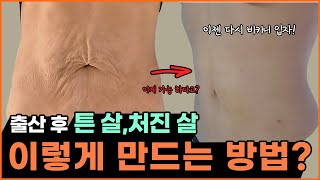 7:56 From removing postpartum stretch marks to firming a sagging belly when exercise isn't enough (Korean) Dr. Park's channel · 2025.02.19
-
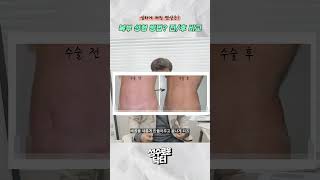 0:35 When exercise won't fix a sagging belly (Korean) Dr. Park's channel · 2025.02.20
-
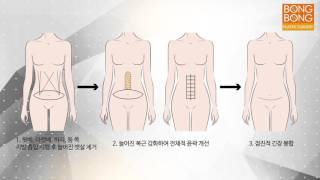 2:07 Abdominoplasty at BongBong Plastic Surgery (Korean) BongBong official · 2015.11.27
Frequently asked questions (FAQ)
My belly looks thicker after abdominoplasty — is that normal?
Right after surgery, swelling from liposuction and tissue removal can make the abdomen temporarily look thicker. Major swelling subsides over the first 2–4 weeks, and the abdominal line gradually appears as residual swelling decreases.
Will all the swelling be gone in a month?
No. Major swelling is much reduced at a month, but residual swelling can remain. It can subside further over about 2–3 months.
Can I exercise one month after abdominoplasty?
Light walking is possible from early on, but full exercise and heavy weight training generally start after 4–6 weeks. Exercise that strongly engages the abdomen should be restarted gradually after your recovery is checked.
Some areas feel firm after abdominoplasty — is that okay?
During recovery, the abdomen can feel firm or tight as tissue heals. This usually softens over time. But if severe pain, heat, redness or a sudden increase in swelling occur together, have it checked by your clinic.
When does the abdominoplasty result look most natural?
It is best to judge at about 3 months. Residual swelling keeps subsiding until then and the abdominal line stabilizes; after that, the scar gradually fades over several months.
📖 References
Click a [number] in the text to jump to its source, and ↩ to return. Only papers whose title, journal and year were verified on PubMed are listed.
- ↩ van der Sluis N, van Dongen JA, Caris FLS, Wehrens KME, Carrara M, van der Lei B. Does Scarpa's Fascia Preservation in Abdominoplasty Reduce Seroma? A Systematic Review. Aesthet Surg J. 2023;43(7):NP502-NP512.PMID 36747469 · DOI— systematic review of Scarpa's fascia-preserving abdominoplasty — analysis of seroma and drain output reduction
- ↩ Salari N, Fatahi B, Bartina Y, et al. The Global Prevalence of Seroma After Abdominoplasty: A Systematic Review and Meta-Analysis. Aesthetic Plast Surg. 2021;45(6):2821-2836.PMID 34080041 · DOI— abdominoplasty, 143 studies · 27,834 patients — seroma rate 10.9%
BongBong Plastic Surgery · Dr. Park Seong-Soo, Medical Director
Contact us for a consultation