Some people still have loose skin on the abdomen after losing weight through diet or exercise, or are concerned that their belly has lost much of its firmness after childbirth and weight changes. In these cases, liposuction alone, which simply removes fat, is unlikely to improve the loose skin as well. Abdominoplasty, which can be considered here, is surgery that tidies the fat remaining in the abdomen with liposuction and then excises loose skin and tissue to make the abdominal line smooth and firm.
Contents
What is abdominoplasty?
Abdominoplasty is surgery that improves the shape of the abdomen by tidying abdominal skin and subcutaneous fat that have lost elasticity and stretched. If the abdomen has a lot of fat and the skin has also stretched, removing fat alone is unlikely to create a satisfying abdominal line, because even when liposuction reduces fat volume, skin that has already stretched can remain. The same problem can arise when skin has stretched a lot after rapid weight loss or childbirth. In this case, abdominoplasty can tidy unwanted abdominal fat with liposuction and remove the loose skin and tissue that liposuction alone leaves behind, smoothing the abdominal surface. In other words, the core of abdominoplasty is not simply "losing belly fat" but correcting fat and loose skin together to refine the overall shape of the abdomen.
In a meta-analysis of 17 studies (14,061 patients) comparing abdominoplasty combined with liposuction (lipoabdominoplasty) with conventional abdominoplasty, the combined approach had fewer complications, with fewer hematomas and seromas reported.[1]
How abdominoplasty differs from liposuction
Abdominoplasty and liposuction are both used to improve abdominal shape, but their purposes differ. Liposuction is surgery that removes fat. A cannula is inserted through a small skin incision to remove subcutaneous fat and refine the volume and shape of specific areas. Abdominoplasty, on the other hand, adds the excision of loose skin and tissue to liposuction. So if there is a lot of belly fat but skin elasticity is relatively well preserved, liposuction alone can improve the abdominal line. Conversely, if fat needs to be removed while the skin has also stretched, folds or wrinkles a lot, abdominoplasty may be the appropriate method. In particular, when the lower belly skin has stretched a lot after childbirth or rapid weight loss, liposuction alone may leave excess skin that keeps the abdomen from looking smooth. In such cases, considering fat removal and excision of loose skin together is the core of abdominoplasty.
Who needs abdominoplasty
Abdominoplasty is not just for people who weigh a lot. It can be considered in the following cases.
When the lower belly skin has stretched badly after dieting
When the abdominal skin sags and has lost elasticity after childbirth
When loose skin remains on the abdomen after major weight loss
When there is abdominal sagging that liposuction alone cannot fix
When the abdomen has both fat and loose skin
When abdominal skin folds over trousers or underwear
When wrinkles and looseness of the abdominal skin make the overall silhouette look heavy
In particular, "I lost the weight but the loose skin on my belly is still there" is the typical situation that leads people to consider abdominoplasty. When abdominal skin has stretched from rapid weight loss or aging, liposuction alone can leave loose skin behind, so skin excision and abdominoplasty can be performed.
Related readingHow to judge whether abdominoplasty suits a postpartum abdomen is covered in "My belly won't go back after childbirth — is abdominoplasty the answer?" (Korean).
Four types of abdominoplasty
Abdominoplasty can be divided into several types depending on the amount of abdominal fat, the degree of skin sagging and the correction range.
| Mini abdominoplasty | Mini abdominoplasty mainly improves skin sagging centered on the lower belly. Rather than correcting the skin of the whole abdomen extensively, it can be considered when loose skin is concentrated on the lower belly. |
|---|---|
| Full abdominoplasty | Full abdominoplasty covers a wide area of the abdomen. It tidies skin and fat across the abdomen, including around the navel, and excises stretched tissue to improve the overall abdominal line. |
| Extended abdominoplasty | It corrects not only the center of the abdomen but also the abdominal line that extends widely to the flanks. When the boundary between abdomen and flanks is not distinct and fat and skin sagging continue to the sides, a wider range can be considered. |
| 360-degree abdominoplasty | 360-degree abdominoplasty considers the overall body shape, including the abdomen, flanks and waist, rather than only the front of the abdomen. Its purpose is not just to reduce the belly seen from the front but to refine the waist and side lines too, improving the silhouette of the whole torso. |
So rather than choosing abdominoplasty by its name, it is important to first confirm how far fat will be removed and how far stretched tissue will be corrected.
How is abdominoplasty performed?
Abdominoplasty starts by assessing the amount of abdominal fat and the degree of skin sagging and designing the incision range and correction direction. Then abdominal liposuction is performed to tidy unwanted abdominal fat. In this technique, the liposuction range is set widely — from above the navel to below the chest and the front flanks — to refine the overall volume of the abdomen. Next, dissection is performed to remove loose skin and tissue. A feature here is that, rather than wide dissection, a micro-dissection of about 7 cm — roughly the width of a palm — is used. The stretched abdominal tissue is then pulled downward and tidied, and the incision is lowered to the bikini line and sutured. Abdominoplasty is not surgery that ends with simply cutting away skin. Tidying volume with liposuction, removing stretched tissue, and then pulling the remaining skin in the appropriate direction to shape the abdomen all happen together.
Why stretched tissue is removed after liposuction
Liposuction and skin excision are performed together in abdominoplasty because fat and skin are different problems. Liposuction can remove subcutaneous fat, but it is not surgery that returns already-stretched skin to its original state. For example, if abdominal fat has decreased after major weight loss but the skin hangs loosely, removing more fat will not make the loose skin disappear. In fact, if a lot of skin remains, wrinkles or folds can form on the abdomen. In such cases, abdominoplasty, which directly removes loose skin and tissue, can tidy the abdominal surface. So if the abdomen has a lot of fat and the skin is also loose, liposuction alone may not be enough. Abdominoplasty is surgery that checks and corrects both the amount of fat and the excess skin to solve this problem.
What abdominoplasty can achieve
The main purpose of abdominoplasty is to tidy a loose abdomen and create a smoother, firmer abdominal shape. Specifically, the following changes can be expected.
Reduction of excess abdominal subcutaneous fat
Removal of loose abdominal skin and tissue
Improvement of lower belly skin sagging
Fewer wrinkles and folds in the abdominal skin
A tidier abdominal line
Improved body shape where the abdomen meets the flanks
Correction of navel shape
In particular, a feature of this technique is that, while tidying abdominal tissue through micro-dissection, umbilicoplasty to create an ideal vertical navel can be performed at the same time. However, abdominoplasty is not obesity treatment aimed at weight loss. Liposuction, too, is aimed more at correcting the shape of specific areas than at reducing weight, so before surgery it is important to check the amount of abdominal fat and the degree of skin sagging rather than body weight itself.
In a study evaluating abdominoplasty patients' quality of life with a questionnaire (BODY-Q), scores rose significantly in every domain after surgery compared with before.[2]
What to check before surgery
Abdominoplasty has a wider surgical range than liposuction and may include skin excision, so accurate assessment before surgery is important. First, the amount of abdominal fat, the degree of skin sagging, flank fat and the overall abdominal shape must be checked. Also, because the incision is lowered to the bikini line, you should check the location and shape of the scar in advance. After abdominoplasty, an incision scar remains on the lower abdomen; it can gradually fade over time, but the scar itself does not disappear completely. After surgery, swelling, bruising and sensory changes can appear, and complications such as bleeding, hematoma, infection, seroma, skin necrosis and wound dehiscence can also occur. Asan Medical Center in Seoul advises a typical recovery period of about 3 weeks after abdominoplasty, and actual recovery speed can vary with the extent of surgery and individual condition. So when deciding on abdominoplasty, rather than looking only at how much fat is removed, it is important to also check the liposuction range, skin excision range, dissection method, incision location and whether umbilicoplasty is included.
Abdominoplasty: common myths and facts
| What many people think… | What the evidence shows |
|---|---|
| "Abdominoplasty is surgery to lose belly fat." | It is not weight-loss surgery but surgery that changes shape by tidying loose skin and fat. |
| "Liposuction alone will make the belly smooth." | When skin elasticity is reduced, removing fat can make the loose skin more visible. |
| "All abdominoplasty is the same surgery." | The range varies with the extent of sagging: mini, full, extended, 360-degree and more. |
In abdominoplasty consultations, I always look at the abdomen in a seated position. Even if it looks fine standing, if the skin folds into several layers when you sit, the skin rather than fat is the main problem.
Abdominoplasty is not surgery that only removes fat but surgery that corrects the shape of the whole abdomen through liposuction and excision of stretched tissue. Its biggest feature is that it can directly tidy the loose skin that liposuction alone may leave behind, especially when abdominal fat and skin sagging occur together, as after childbirth or rapid weight loss. Because the correction range also varies — mini, full, extended and 360-degree abdominoplasty — it is important to look beyond the front of the abdomen, assess the overall body shape including the navel and flanks, and then decide on the appropriate surgical range. And by also considering tissue tidying through micro-dissection, a bikini-line incision and vertical umbilicoplasty, the goal can go beyond simply reducing belly fat to creating a smooth, firm abdominal line and a natural navel shape.
🔬 Supporting research
Peer-reviewed international journal articles that support this article. Click a title to open the PubMed abstract.
- Aesthetic plastic surgery 2019 — abdominoplasty meta-analysis, 17 studies · 14,061 patients Safety of Lipoabdominoplasty Versus Abdominoplasty: A Systematic Review and Meta-analysis. Key finding: fewer complications with liposuction combined (RR 0.85) In text [1] · PMID 30511162 · DOI
- Plastic and reconstructive surgery 2022 — BODY-Q in 183 abdominoplasty / fat excision patients Impact of Panniculectomy and/or Abdominoplasty on Quality of Life: A Retrospective Cohort Analysis of Patient-Reported Outcomes. Key finding: quality of life improved in all domains after surgery In text [2] · PMID 35877928 · DOI
🎬 Watch — Dr. Park Seong-Soo · BongBong Plastic Surgery
Related videos from BongBong Plastic Surgery's official channel and Dr. Park Seong-Soo's channel. Videos are in Korean and play on YouTube.
-
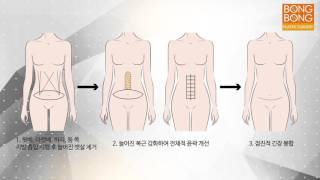 2:07 Abdominoplasty at BongBong Plastic Surgery (Korean) BongBong official · 2015.11.27
-
 7:56 From removing postpartum stretch marks to firming a sagging belly when exercise isn't enough (Korean) Dr. Park's channel · 2025.02.19
-
 0:50 Why wear an abdominal binder after abdominoplasty, and for how long? (Korean) BongBong official · 2021.11.01
Frequently asked questions (FAQ)
Are abdominoplasty and liposuction the same surgery?
No. Liposuction is surgery that removes abdominal subcutaneous fat to refine body shape, while abdominoplasty combines liposuction with excision of loose skin and tissue to also correct abdominal sagging.
Can a loose belly after childbirth be improved with abdominoplasty?
Yes. If abdominal skin has stretched and fat remains after childbirth, the abdominal shape can be improved with liposuction and excision of loose skin.
I lost weight by dieting but my belly skin hangs loosely — do I need abdominoplasty?
If a lot of loose skin remains on the abdomen after weight loss, abdominoplasty can be considered, because liposuction alone cannot remove skin that has already stretched.
Can my navel be changed with abdominoplasty?
The position and shape of the navel can be corrected during abdominoplasty. In particular, in surgery using minimal dissection, vertical umbilicoplasty can also be performed at the same time.
Where does the abdominoplasty scar remain?
An incision line generally remains on the lower abdomen and can be designed to sit close to the bikini line. The scar can fade over time but does not disappear completely.
Is abdominoplasty surgery to lose weight?
Abdominoplasty is not surgery aimed at weight loss. It is surgery that corrects abdominal shape by reducing abdominal fat with liposuction and removing loose skin and tissue.
📖 References
Click a [number] in the text to jump to its source, and ↩ to return. Only papers whose title, journal and year were verified on PubMed are listed.
- ↩ Xia Y, Zhao J, Cao DS. Safety of Lipoabdominoplasty Versus Abdominoplasty: A Systematic Review and Meta-analysis. Aesthetic Plast Surg. 2019;43(1):167-174.PMID 30511162 · DOI— abdominoplasty meta-analysis, 17 studies · 14,061 patients — fewer complications with liposuction combined (RR 0.85)
- ↩ Rios-Diaz AJ, Morris MP, Elfanagely O, et al. Impact of Panniculectomy and/or Abdominoplasty on Quality of Life: A Retrospective Cohort Analysis of Patient-Reported Outcomes. Plast Reconstr Surg. 2022;150(4):767e-775e.PMID 35877928 · DOI— BODY-Q in 183 abdominoplasty / fat excision patients — quality of life improved in all domains after surgery
BongBong Plastic Surgery · Dr. Park Seong-Soo, Medical Director
Contact us for a consultation